

More babies, please
It's a simple solution ... Nothing to see here ... And Tom's priorities.
If we told you that Arizona public schools are losing students at an alarming rate, you’d probably point to school vouchers, charter schools, and homeschooling as the obvious culprits.
And you’d be partly right — but that’s not the whole story.
The bigger reason for the decline? People are having fewer babies.
Arizona’s birth rate peaked in 2007. That was 18 years ago. Those kids are graduating high school this year, and every class that comes after them will be smaller than the last.
That means traditional public schools face the unprecedented challenge of competing for a shrinking student pool in an increasingly crowded marketplace of charter schools and universal vouchers.
And this demographic shift is quietly reshaping Arizona’s education landscape, affecting everything from school budgets to the demand for new school buildings.
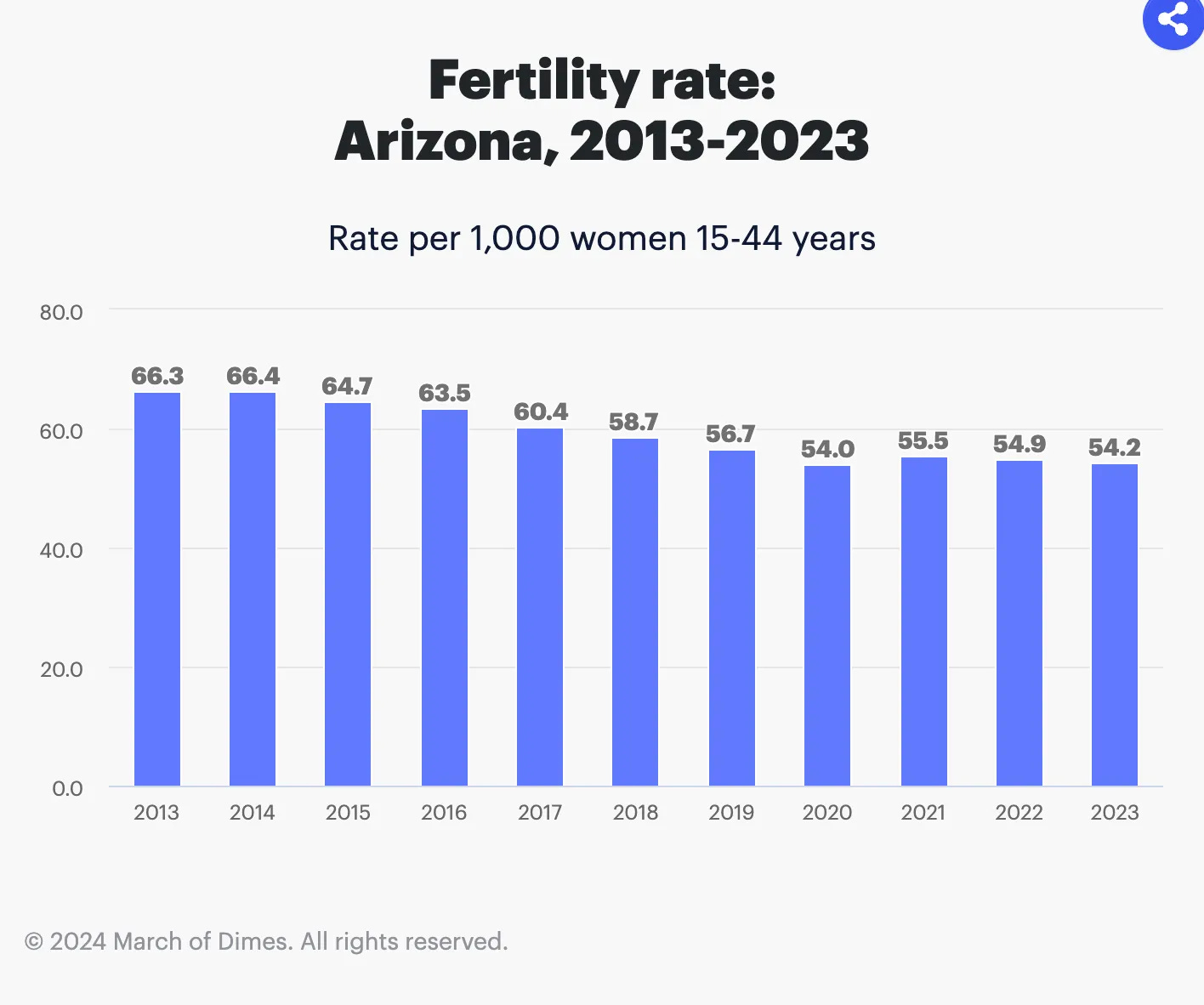
Birth rates across the U.S. have been in decline for decades.
But 18 years ago, Arizona was still making babies faster than the national average.
Today, Arizona’s baby-making rate is a lot like our per-pupil funding rate: We rank near the bottom.1
Schools in Arizona are primarily funded on a per-student basis, so fewer kids mean less money. That’s already having a profound impact on some of the state’s largest school districts, like Mesa Public Schools, which is laying off teachers as enrollment drops.
Mesa schools lost about 1,800 kids this year, resulting in a roughly $17 million budget shortfall.2
The district hasn’t disclosed how many teachers it’s laying off this year. But just last year, it cut about 400 positions, including nearly 200 teachers, citing declining enrollment and expiring federal pandemic money.
Mesa isn’t an outlier. Declining enrollment has forced:
Roosevelt Elementary School District to close five schools in December.
Paradise Valley Unified School District to close three schools last year.
Tempe Union High School District to lay off 40 teachers last year
Cave Creek to consider closing two of its schools right now.
And the list keeps growing.
Much of the blame for declining public school enrollment falls on Arizona’s radical school choice initiatives — and much of it is deserved.
More than 30 years ago, Arizona introduced “open enrollment,” allowing students to attend any public school they choose, not just the one in their neighborhood. That sparked migration from struggling urban districts to more affluent suburban ones. But it didn’t change the total number of kids in public schools.
A decade later, charter schools took off.
While technically public schools, charters are run by private organizations, not school districts. When a student leaves a district school for a charter, the per-pupil funding follows them. Today, over 200,000 Arizona kids attend charter schools, though that number has mostly plateaued since 2017.
Then came Arizona’s universal school voucher program.
More than 83,000 students use Empowerment Scholarship Accounts, costing the state an estimated $1 billion annually. That’s money that could have gone to public schools — but most of it wouldn’t have anyway, since the majority of ESA recipients were already attending private schools.
The true hit to public school enrollment from vouchers is likely under 25,000 students.3
By comparison, if Arizona had kept its birth rates at 2007 levels, we would have around 500,000 extra kids by now.

The pandemic brought a slight bump in birth rates and a steep decline in the number of kids attending public schools. Both of those trends are starting to level out.
But the pandemic’s most dramatic effect on schools was to fundamentally shift how many families think about education.
Thousands of students disappeared from the system entirely, unaccounted for in any enrollment data. Coupled with the introduction of universal ESAs, Arizona’s public schools are now navigating a new and uncertain paradigm.
The ripple effects of declining enrollment can be devastating. As traditional public schools lose students, they lose funding — a vicious cycle that forces more cuts, larger class sizes, and school closures. This, in turn, drives even more families to seek alternatives, accelerating the exodus.
That death spiral also challenges schools’ economies of scale: public schools are designed to educate large groups of students efficiently. When enrollment drops, the cost of operating facilities and paying staff remains largely the same, leaving districts to make difficult choices about how — and where — they can afford to operate.
So what’s the solution? Consolidate schools? Reform funding models? Sure.
But if we’re being honest, the most straightforward long-term fix is also the least realistic: Someone’s going to have to start having more babies.

We told you last week about the meltdown at the West Valley’s Isaac School District. Basically, the administration has bungled the district’s finances so badly that the state is stepping in to appoint a “receiver,” or an independent third party to manage its expenses.
The only hope teachers there have to continue getting paid is if the Maricopa County Board of Supervisors essentially extends them a line of credit — and fast.
Maricopa County Treasurer John Allen said that without the supervisors’ intervention, he won’t cut any more checks for the district and teachers won’t get paid next week.
Well, the supervisors are scheduled to meet on Monday, though it’s not clear if they’ll agree to cover for the district.
Meanwhile, the district is holding its first post-takeover governing board meeting tomorrow night, and the board plans to welcome their new receiver: Keith Kenny. Tune in to watch the drama!
But what really gets us about this story is the letter that the district sent to parents downplaying the disaster and promising “the day-to-day operations of our schools will continue as usual.”
That’s true…At least, for now.

We’re using our legislation-tracking service, Skywolf, to keep track of all the education bills flying through the state Capitol this year.
So far, we’ve got 69 bills on our tracking list. And we’re adding more every day!
Paid subscribers to the Education Agenda can track all the education action with our live tracking list, which is updated instantly as bills move through the process.
If you’re a paid subscriber, check the footer of this email for the link. Otherwise, click the button to follow along!

We’re visual learners. So we love a good chart.
The governor’s budget proposal is packed with visualizations of all the numbers and stats you could want to visualize.
You can watch the whole budget presentation here or download the documents here.
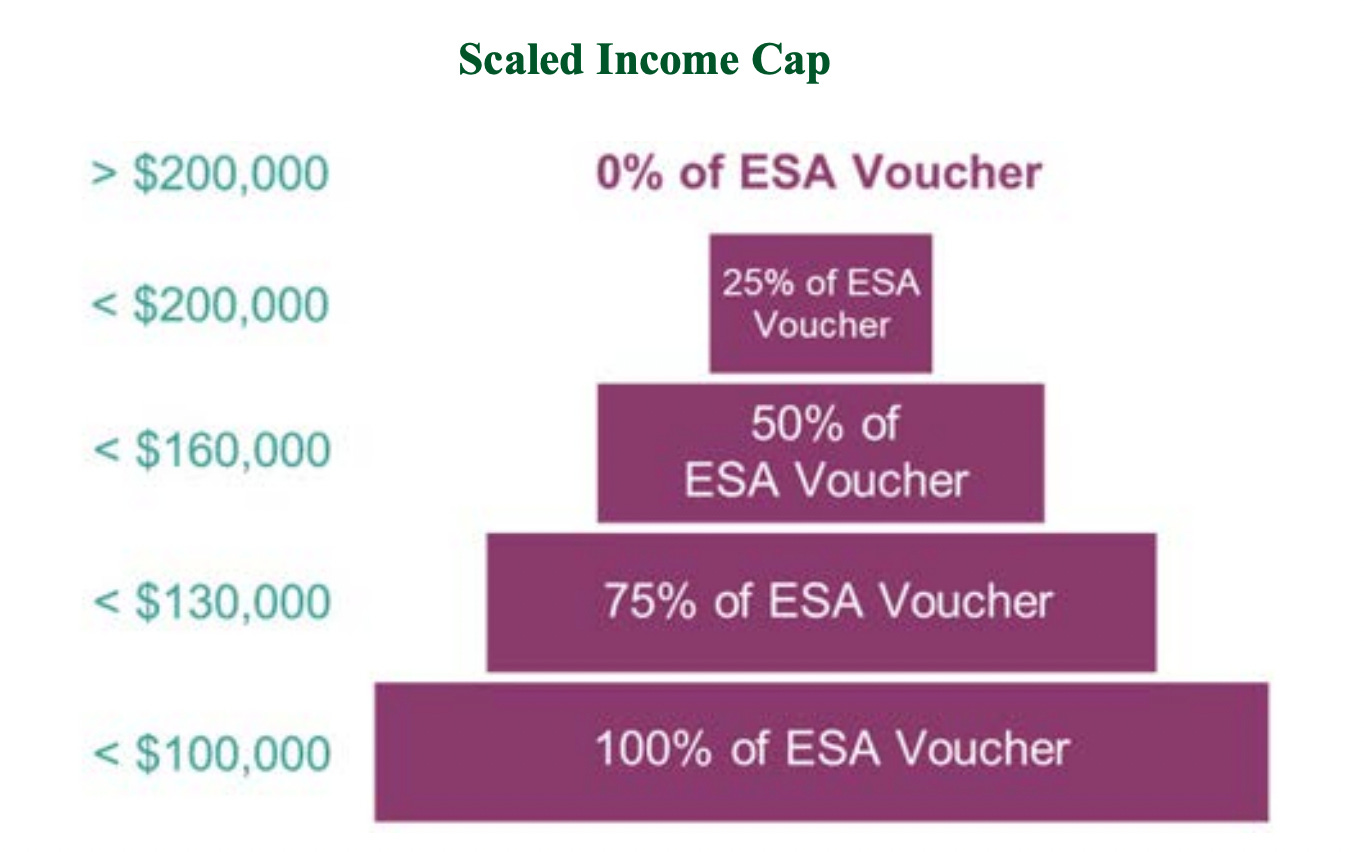
But if there’s one simple graphic that Education Agenda readers should memorize, it’s the one visualizing her proposal for putting income caps on school vouchers.

When Arizona Superintendent of Public Instruction Tom Horne delivered the annual “State of Education” speech to the House Education Committee yesterday, he came prepared with a slideshow of his priorities.
The first slide was just a title page.
The second slide discussed his “focus on academics.”
The third slide was this.
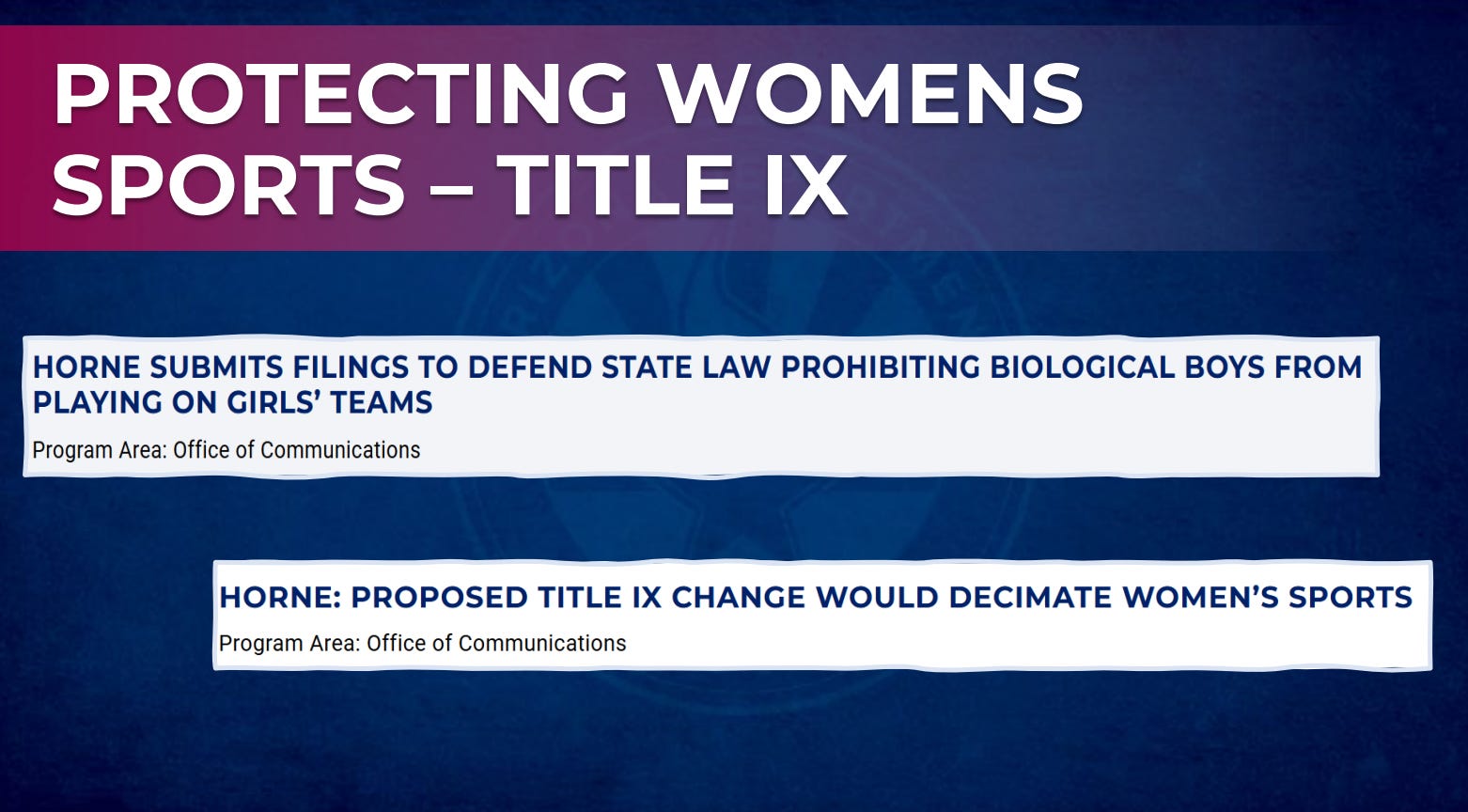
Only later did he get to the apparently lesser challenges facing schools, like Arizona’s teacher shortage, the expiration of Prop 123 and the $300 million annually that comes with it, or the need to lift the Aggregate Expenditure Limit so schools don’t have to make massive cuts before the end of the school year.
That drop in birth rates has been largely fueled by Hispanic women having babies at a lower rate and fewer young women having children, as ABC15’s data guru Garrett Archer helpfully explains.
Statewide, Arizona’s public school system will face an estimated $28 million cut this year due to declining student enrollment, per the governor’s budget projections.
That 25,000 ESA students came from district schools is based on some back-of-the-napkin math, but it’s the best we can do considering the deliberately vague data Arizona collects about voucher recipients. Also, many of those kids who did transfer from public schools have disabilities and receive higher funding awards, so even without vouchers for private school kids, the program would still cost around $450 million, per the Governor’s Office.
Is anyone considering revisiting the consolidation of school districts? Asking because, while the initiative to do that some years ago failed, current circumstances (collapse of Isaac school district and struggles of other traditional government school districts) appear to warrant action along those lines. Put another way, it sure seems like having so many districts (58 school districts in Maricopa County alone) not only increases administrative costs but leads to a lack of real time accountability.
Tracking the evolving story of this week’s disclosure that 47 traditional government school districts face financial peril: (1) the alternative under discussion, folding some of these districts into more financially, healthy districts is one alternative - what also should be considered is whether it is feasible to place these kids in a more effective (both from a cost and learning perspective) alternative, for example, a charter school willing to expand or establish outposts in these areas (for example, Vista prep operates five thriving and effective schools in the same service area covered by the Isaac/Roosevelt districts), and (2) another useful area of inquiry would be the role played by the many education NGO’s in public education (having been a donor/volunteer in the education space for over 30 years, one of my great frustrations has been the explosion of nonprofits established by well-meaning philanthropists and activists, most of whom simply add to the “noise” and don’t do the hard work of actually educating kids - in the process, these organizations siphon off significant resources while diverting much of the best talent in education - IMO, this ends up distorting the discussion and does not lead to actually educating kids). Matt Ladner would be a great resource on this front, along with educators who are still active in the trenches (meaning operating and/or teaching in actual schools).